Why online education won’t work in Emerging Markets
 Sam Bhattacharyya
Why online education won’t work in Emerging Markets
Online Education Today:
Online education is as old as the internet, but it took a significant leap around 2005 towards online video, with services like Youtube enabling Salman Khan and others to pioneer the concept of free, open, online education through video based tutorials. 2012 was the year of the MOOC, with the likes of Udacity, Coursera and edX took online education one step further with the Introduction of ”Massively Open Online Education” (MOOCs).
[caption id=”” align=”aligncenter” width=”480"]
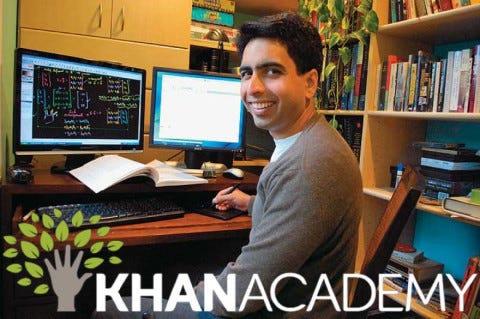
Khan Academy, one of the most popular Online Education platforms[/caption]
As of 2016, video-based online education has taken a wide plethora of forms, from university style lectures from services like edX, to professional skills development from services like Skillshare, Lynda.com or CodeAcademy, to popular youtube education channels such as Crash Course or Sci Show, several of which have nearly as many subscribers as edX.
[caption id=”” align=”aligncenter” width=”445"]

Crash Course is a popular educational youtube channel[/caption]
Despite the oversaturation wide variety of online education resources, most involve the learner sitting down at a laptop for 20 minutes to an hour, maybe with a cup of coffeee, to watch some combination of videos, interspersed with quizzes or exercises, in a linear sequence with a start and a finish. Despite the criticism, I think Online Education is a hit succcess — with no better proof than that I’ve been able to build (dot Learn and TeachX) entirely by myself, with no formal background in CS, using just what I learned from Academic Earth, Khan Academy and Udacity.
Online Education was never designed for Emerging markets
Yet, somehow, a free world class education at my fingertips seemed like little consolation at 2 in the morning, sitting at a lonely computer in a dingy internet Cafe in rural Mexico.
I used to be a Peace Corps Volunteer, teaching math and science in a quiet town in rural Mexico. In the evenings I would use my spare time to learn programming, as well as to brush up on the material I would teach my students. The only problem was that the only place to get broadband internet was in the only internet café in town, and even there the internet was too poor to stream video reliably, except between 11pm and 8am.
[caption id=”attachment_35" align=”aligncenter” width=”512"]

My home in rural Mexico[/caption]
And this was my expereince an Ivy Leage educated, highly motivated self learner. I asked myself if any of my US friends would even bother with online education in similar circumstances. If that is the case, then how can we expect students in Brazil, Bangladesh and Botwsana, who already live in countries with less than stellar public education systems, to compete with students in the US who have ready access to free, convenient, world-class education?
How the world actually works
Outside of Cambridge or Palo alto, the world works a bit differently. Not everyone has an ipad, and not everyone has wifi at home. Here’s a typical street in Accra, Ghana — nothing particularly special about it.
[caption id=”attachment_21" align=”aligncenter” width=”600"]
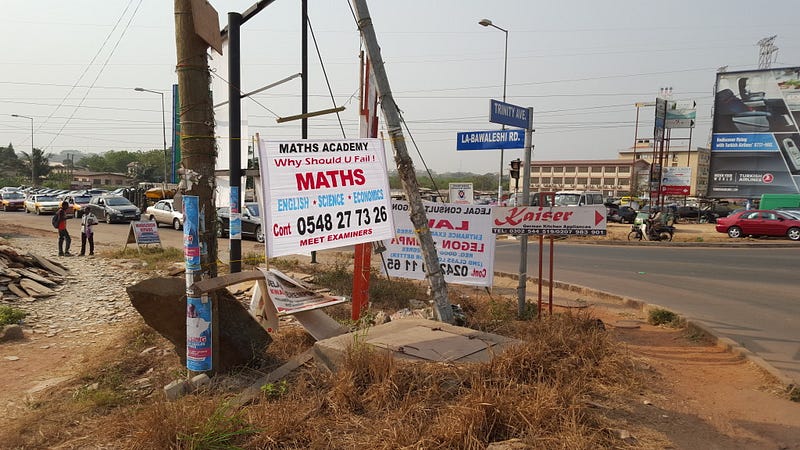
A typical street in Accra, Ghana[/caption]
Ghana is a perfect example because it’s just a bit below the global average on the Human Development Index. It is, therefore, probably as good as you’re going to get if you wanted to understand how the world actually does work, and especially emerging markets.
The first lap, not the last mile
We highly overestimate global connectivity. As you can see by large-scale initiatives such as Mark Zuckerberg’s internet.org , or Google’s project loon, connectivity is a challenge for billions of people. Right now only about 10% of the world’s population has regular access to the fixed broadband level internet typically associated with consuming services like Netflix. People often call this the ‘The last mile’ problem, but I’ve never seen another task where ‘The Last Mile’ was 90% of the work. If we’re in a race to global broadband connectivity, we’ve only passed the first lap.
It’s like this to stay
It’s a fantasy to imagine every rural farmer enjoying high speed internet on her/his laptop anytime soon. Best estimates suggest that fixed broadband won’t reach 30% of the world until 2030. To understand why, consider that (1) Internet is Infrastructure (2) Availability =/= access
To understand why, it is important to understand that expanding fixed broadband internet requires capital intensive infrastructure., a figure which is equivalent to one year’s income for the average person in India, with the cost even higher in more rural areas.
Internet is infrastructure
It costs money to lay down fiber-optic cables — about $1500 USD per household globally, less in developed areas and more in rural areas. Fiber-optic infrastructure faces economies of scale, making it much cheaper to provide in areas which already have it, and much more expensive to provide in new areas.
[caption id=”” align=”aligncenter” width=”642"]
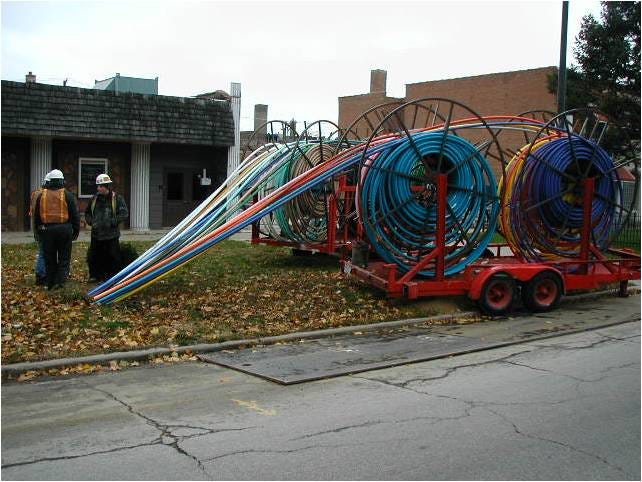
Laying out broadband is Infrastructure intensive[/caption]
Consider India. As of 2015, only 15 million people (~1% of the population) had fixed broadband internet, which means that there are 1.265 billion people (~263 million households) that are not connected to broadband, growing to 300m by 2025. Given the $1700 USD per household cost to connect in India, it would cost at least 510 billion dollars to fully connect India to fixed broadband over 10 years.
If that cost is distributed over 10 years (adjusting for growth), India would need to spend 6x as much on Infrastructure as it did in 2014. When basic infrastructure (electricity, transportation, hospitals, schools) is still a challenge, it seems criminally negligent to prioritize infrastructure spending on fixed boadband internet, because electricity and health care are more important than kitten videos.
People don’t use broadband because it’s just too expensive
You might be forgiven for thinking that large urban cities which have plenty of internet are already connected. Many many people don’t have fixed broadband, not because it’s not available where they live, but rather because it’s too expensive to subscribe.
For the same economies of scale reasons mentioned above, broadband is more expensive in the developing world — which compounds with lower ability to pay.
When the average American earns $50k / year and has to pay $50/mo for broadband, while the average Ghanaian earns $1.5k / year and has to pay $100/mo for broadband, you kind of get why so many people just don’t use broadband.
Khan Academy is so expensive, it’s cheaper to just buy a tablet
Because broadband is so expensive, most can’t afford to access “free” education platforms like Khan Academy. This makes it cheaper to just buy a $200 tablet pre-loaded with the videos and study materials, which enough students actually do to feed a growing market.
[caption id=”attachment_22" align=”aligncenter” width=”500"]
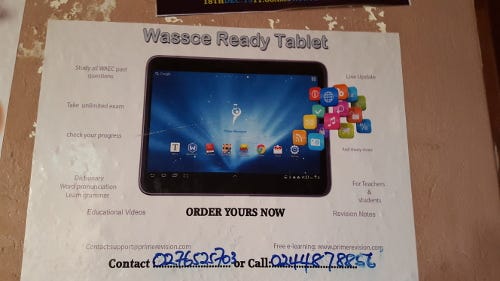
Tablets pre-loaded with test-prep materials for “WASSCE” — the national college entrance exam, on sale for $200 USD[/caption]
Not everyone buys study tablets, but others spend equally appallingly high amounts of money ($50 — $100 USD) on study materials which would otherwise be served for free on platforms like Khan Academy in the US.
People are leapfrogging to mobile broadband
Because mobile is cheaper and more accessible, emerging markets are leapfrogging fixed broadband for mobile internet. By 2020, 80% of internet users will be connecting primarily or solely through a mobile device. It’s a fundamentally different kind of internet though, and presents two challenges for online education.
Screen size: While most platforms have mobile apps, the apps are just boiled down services of the web platform. Khan Academy, for example, still doesn’t support exercises on mobile. You also have a UI problem where 2 hours of video provides a much worse experience on a 3.5" screen than it does on a 13" screen.
Data costs: Most people pay per MB of mobile data, and as initiatives like internet.org show, users are sensitive even about kB of data, let alone GB. When an average MOOC has 15Gb of video, which costs $80USD to stream on 2016 rates in Ghana, Online Education platforms are going to face a huge challenge in emerging markets.
Coming up with a Solution
So, while there is opportunity and connectivity in emerging markets, Online Education platforms will need to figure out how to make it work on the devices and internet connections that are increasingly becoming dominant globally: Mobile devices and Prepaid Mobile data connections.
Our technology solves exactly these issues, and we believe that the future of online education in emerging markets will be what we’re developing, or something based off of it. If you want a sneak peak at what we’re doing, check us out or check back here for more updates.
All data and references in this article can be found in http://www.dotlearn.org/paper.pdf